
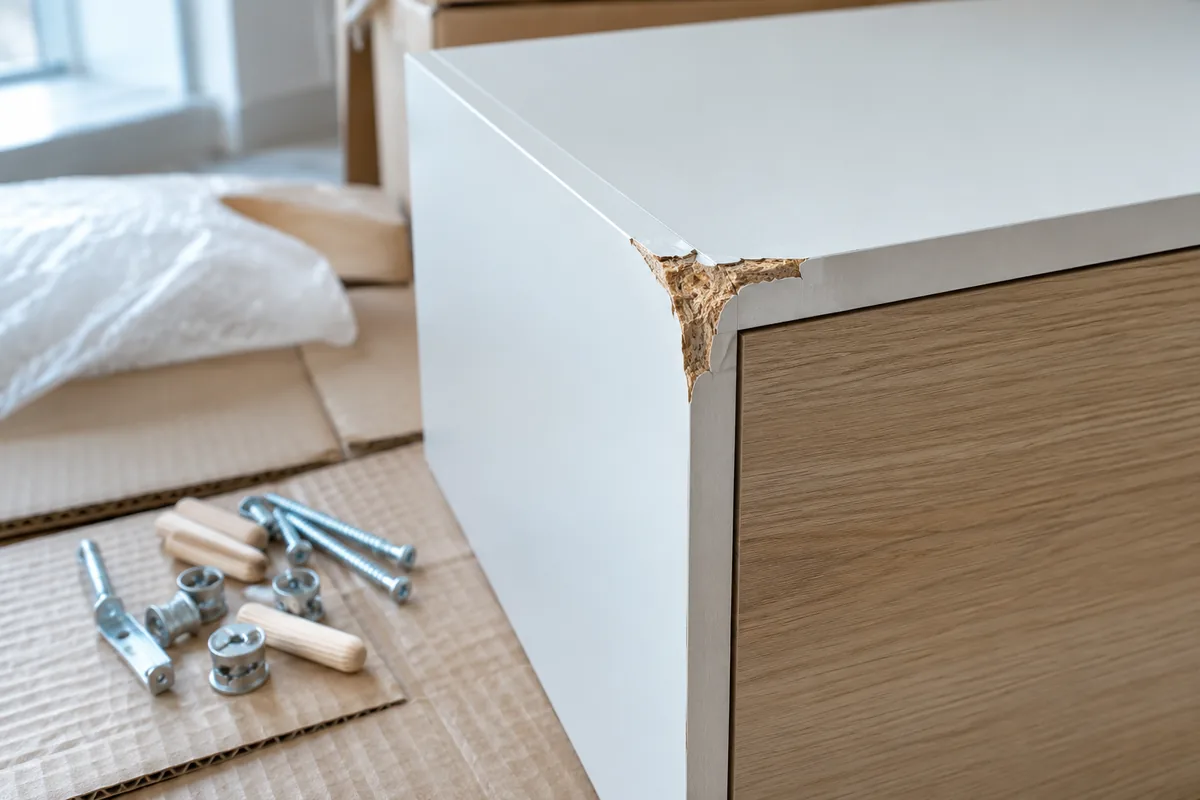
A chip in furniture after delivery may be connected with transport, unpacking, assembly or an earlier condition of the part. To test these explanations, retain the sequence of handovers and interventions rather than relying only on an overall photo of the finished wardrobe.
Separate the stages
State when the furniture was delivered, who unpacked it, when assembly began and at which stage the defect was discovered. If the packaging was already damaged, retain evidence of its condition and the notes in the documents. If the defect was noticed later, do not backdate its discovery to delivery without supporting evidence.
Materials for each object
- Order, diagram, specification and handover documents.
- Overall view of the item and identification of the damaged part.
- Condition of boxes, protective inserts and fastenings.
- Assembler's documents and list of operations performed.
- Original photos, videos and relevant correspondence.
Traces of transport and installation
The specialist examines the location, shape and relationship of damage to the design and handling conditions. A chip near a hole does not, by its location alone, prove an assembly error. Nor does an external dent in a box automatically confirm that all defects inside arose during transport.
Do not alter a joint to test a theory
Retightening fasteners, enlarging holes, gluing or repainting can alter traces. Preserve the available condition before inspection where possible. If the furniture was dismantled for safety or transport, describe the sequence of actions and keep the parts separately, labelled with their origin.
Do not use unstable furniture to demonstrate a defect. Safety and necessary emergency measures take priority; document them separately from the subsequent examination.
What is needed for a conclusion on cause
Beyond inspection, information on the original condition, packaging, delivery and assembly may be needed. Where it is unavailable, the expert must distinguish an established mechanism from a hypothesis about the particular stage when the damage arose. Technical possibility alone is not a proven history.
Restoration is discussed after the condition has been established: which parts are affected, whether repair is possible and what is needed to preserve function and appearance. A full replacement estimate must not be adopted merely because it is the most convenient option for one party.